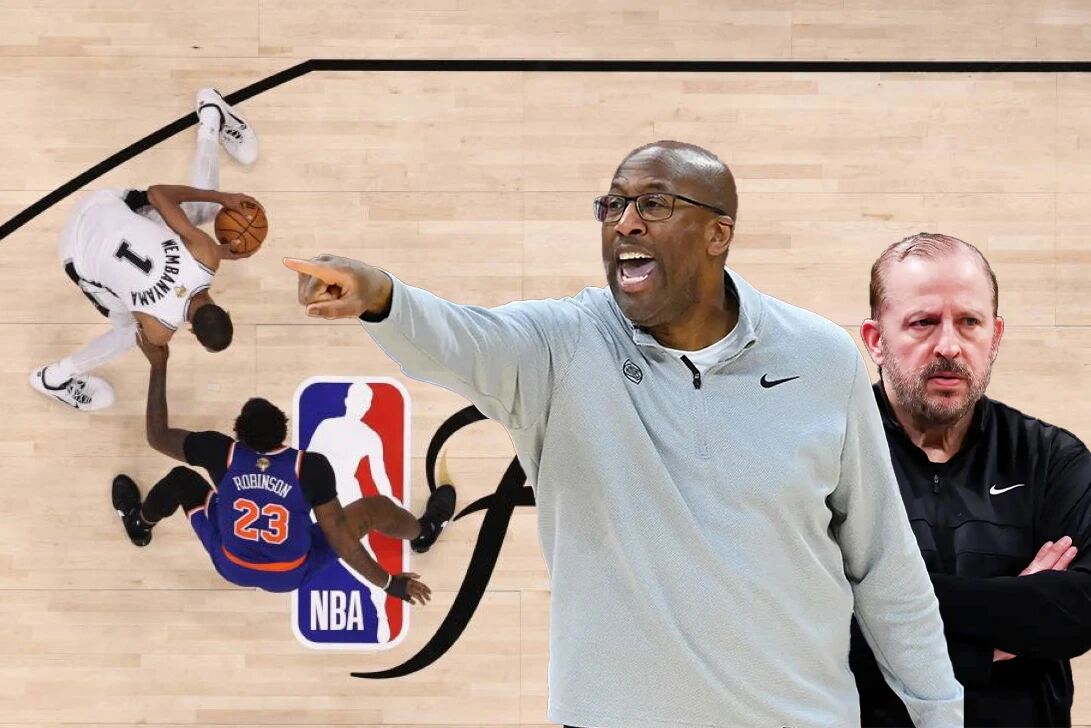
How ball movement, deeper rotations, and modern spacing helped New York reach another level.
A Completely Different Knicks Team
The changes Mike Brown has brought to New York are obvious to anyone watching.
The ball moves more. Isolation plays happen less.
Under Tom Thibodeau, the Knicks relied heavily on isolation scoring and a notoriously rigid rotation. Brown has replaced that approach with a faster-paced offense built around ball movement, three-point shooting, and greater involvement from every player on the floor.
The result is a team that looks far more modern on the offensive end.
The End of the “Five-Horse Rotation”
The most noticeable change can be seen in the workload of New York’s starters.
Fans often joked that Thibodeau operated a “five-horse rotation,” relying heavily on his starting lineup while giving limited opportunities to the bench.
One of Brown’s first priorities was reducing that burden.
The personnel remained the same:
- Jalen Brunson
- Karl-Anthony Towns
- OG Anunoby
- Mikal Bridges
- Josh Hart
But their minutes changed dramatically.
Under Thibodeau
| Player | MPG (Regular Season) |
|---|---|
| Josh Hart | 37.6 |
| Mikal Bridges | 37.0 |
| OG Anunoby | 36.6 |
| Karl-Anthony Towns | 35.0 |
During the playoffs, Anunoby and Bridges approached 40 minutes per game, while the starting five averaged 37.5 minutes.
Under Mike Brown
- Starters averaged 3.9 fewer minutes per game during the regular season.
- Playoff minutes dropped by 4.6 minutes on average.
- Hart’s workload fell from nearly 38 minutes to roughly 30.
- Towns played about four fewer minutes per game.
- Even in the playoffs, the starters saw only a modest increase in playing time.
Brown didn’t change the core players.
He changed how they were used.
More Passing, Less Hero Ball
The changes go far beyond minutes.
Thibodeau’s typical eight-man rotation expanded to nine players, creating more lineup flexibility and fresher legs throughout the season.
More importantly, the Knicks dramatically increased their passing volume.
Under Thibodeau, the offense revolved around Brunson dominating the ball and creating through isolation-heavy “hero ball.”
Under Brown, the offense flows much more naturally.
Brown’s Offensive Priorities
- Quick inbound passes
- Faster decision-making
- Constant ball movement
- Weak-side cuts
- Five-out spacing
- Shared offensive responsibility
Instead of one player carrying the offense, everyone becomes part of it.
Karl-Anthony Towns Is the Biggest Winner
No player has benefited more from Brown’s system than Karl-Anthony Towns.
Brown has fully embraced Towns’ shooting ability and uses him as a key spacing weapon. The five-out offense creates more room for both Towns and Brunson while reducing Brunson’s playmaking burden.
At first glance, Towns’ regular-season assist numbers seem unchanged:
| Season | Assists Per Game |
|---|---|
| Previous Season | 3.1 |
| Current Season | 3.0 |
But the postseason tells a different story.
Playoff Assists
| Season | Assists Per Game |
|---|---|
| Last Playoffs | 1.3 |
| Current Playoffs | 5.6 |
Towns recorded only one double-digit assist game during the regular season.
In the playoffs, he already has:
- 3 games with 10+ assists
- 2 triple-doubles
His role has expanded far beyond scoring.
The Three-Point Revolution
The third major change is shot selection.
Thibodeau Era
The Knicks relied heavily on:
- Mid-range jumpers
- Isolation possessions
- Drives to the basket
Their three-point attempt rate consistently ranked near the bottom of the league.
Brown Era
Brown has aggressively shifted the offense toward:
- More three-point attempts
- Better floor spacing
- Fewer inefficient mid-range shots
Three-pointers now account for roughly 40% of the team’s shot attempts, creating a far more efficient offensive environment.
The spacing improvement is immediately noticeable.
The Warriors Influence
Brown’s offensive philosophy didn’t appear out of nowhere.
He spent six years as an assistant coach with the Golden State Warriors, helping Steve Kerr build one of the greatest dynasties in NBA history.
Brown’s Warriors Resume
- Lead assistant coach (2016–2022)
- Three NBA championships
- Defensive coordinator
- Coached the team to a 12-0 record while filling in for Kerr
Combined, Brown spent nine seasons learning under:
- Gregg Popovich
- Steve Kerr
That experience helped shape his basketball philosophy.
More Than Just a Defensive Coach
For years, Brown was viewed primarily as a defensive specialist.
He began his career as a video coordinator and earned a reputation for detailed preparation and defensive expertise.
When New York hired him, many assumed defense would be his primary focus.
Instead, he transformed the offense.
Brown even addressed that perception himself:
“That’s how people have always viewed me. Those labels are hard to change, so I just smile and let people think what they want.”
Why Brown Succeeded Where Thibodeau Didn’t
In many ways, Brown and Thibodeau are remarkably similar.
Both built their careers through film study.
Both emphasize defense.
Both are detail-oriented coaches.
The key difference is their offensive philosophy.
Throughout his career, Thibodeau often delegated offensive responsibilities to assistants while focusing on defense and overall team management.
Brown took a different path.
After years under Popovich and Kerr, he embraced many of the principles that define modern NBA offense:
- Deeper rotations
- Faster pace
- Better spacing
- More passing
- Higher three-point volume
Those ideas became the foundation of New York’s transformation.
The Modern NBA Demands Change
Thibodeau’s tenure was not a failure.
He guided the Knicks to the Eastern Conference Finals and restored credibility to the franchise.
But it felt as though the team had reached its ceiling.
Brown inherited essentially the same core group and, within one season, pushed it further.
That speaks to the importance of adapting to today’s NBA.
Modern basketball demands:
- Pace
- Space
- Ball movement
- Quick decisions
- Transition offense
- Three-point shooting
Even elite big men are expected to stretch the floor.
The game has evolved.
And so have the Knicks.
Final Thoughts
Mike Brown didn’t rebuild the roster.
He didn’t overhaul the starting lineup.
He simply modernized the way the Knicks play.
The offense that had remained largely unchanged under Thibodeau for decades was transformed in a single season.
And that transformation may have changed the future of the franchise.
